
Executive Summary
Liposomal supplements overcome key limitations of conventional vitamins and nutraceuticals – poor solubility, instability, and low absorption – by encapsulating actives within phospholipid bilayers that mimic human cell membranes.
This paper outlines how liposomes protect sensitive nutrients, enhance intestinal uptake, and deliver markedly higher bioavailability. Multiple clinical studies show multi-fold increases in Cmax, Tmax, and AUC for liposomal vitamin C, glutathione, curcumin, iron, and more.
Modern manufacturing and analytical tools (TEM, DLS, PDI, zeta potential) ensure stable, high performing formulations. With rising demand for clinically validated, high efficacy supplements, liposomal delivery represents a major advancement in modern nutrition.
Need for Nutritional Liposomal Supplements
Preventive health and personalized nutrition have exposed the limits of traditional supplements, which often degrade in the gut, absorb poorly, or cause GI discomfort. Water soluble vitamins like C and B12 are particularly unstable and inconsistently absorbed.
Consumers now prefer clean label, science backed formats with higher efficacy. Liposomal delivery (nanoscale phospholipid vesicles) address these issues by protecting nutrients and enhancing absorption through cell-membrane mimicry.
Limitations of Conventional Supplement Formats
Traditional oral supplements face several persistent challenges:
- Low Bioavailability: Many actives are poorly soluble or rapidly degraded.
- GI Discomfort: Minerals and high dose vitamins often irritate the gut.
- Dose Inefficiency: High doses are needed because much of the nutrient is not absorbed.
- Population Variability: Elderly and malabsorption patients respond especially poorly.
Liposomal systems bypass these issues by offering a protective lipid shell that enhances uptake and reduces irritation.
Liposomal Delivery Systems: Structure and Mechanism
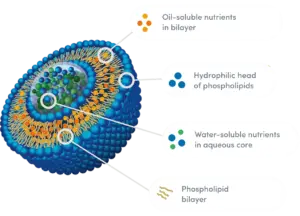
Liposomal supplements use 100 to 400 nm phospholipid vesicles that self-assemble when hydrated. Because their bilayer mirrors human cell membranes, they are efficiently absorbed.
Water-soluble actives are trapped in the aqueous core; lipid-soluble actives embed in the bilayer. After ingestion, liposomes shield nutrients from stomach acid and enzymes, then fuse with intestinal cells or enter via endocytosis to release contents directly inside cells.
These properties improve solubility, stability, and cellular uptake, enabling higher efficacy at lower doses.
Manufacturing Methods for Liposomes
Common techniques include:
- Thin-Film Hydration: Produces multilamellar vesicles, later downsized by extrusion or sonication.
- Ethanol (Injection/Reverse-Phase) Method: Simple, scalable method for forming liposomes during solvent dilution.
- Microfluidization: High-pressure mixing yields uniform nano-liposomes ideal for commercial scale.
- Ultrasonic & High Pressure Homogenization: Reduce vesicle size for research or small-batch output.
Modern approaches emphasize solvent reduction, long-term stability, and scalability.
Liposome Characterization
Ensuring quality and performance of liposomal supplements requires rigorous characterization:
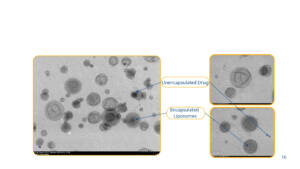
- TEM/Cryo-TEM: Confirms morphology and bilayer integrity.
- Particle Size (DLS): Ideal ranges of 100–400 nm support efficient absorption.
- PDI: <0.5 reflects uniform, stable dispersions.
- Zeta Potential: >±30 mV promotes colloidal stability.
- Encapsulation Efficiency: High-quality systems reach 80–90% entrapped actives.
- Stability Studies: Ensure size and structure remain intact over shelf life.
Clinical Evidences of Enhanced Bioavailability of Liposomal Actives
Numerous studies show superior bioavailability of liposomal nutrients compared to conventional forms:
Liposomal Vitamin C – Enhanced Delivery and Characterization
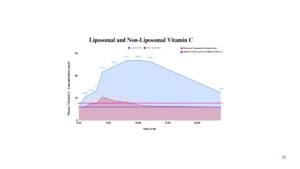
A pilot German study comparing LECIVA-AscoLip with a standard 1000 mg dose of plain Vitamin C showed dramatically higher absorption: >2.5X Cmax, 6X longer Tmax, and 41X higher AUC, confirming far superior and sustained plasma levels.
Additional Clinical Findings
| Nutrient | Study Design | Key Outcomes |
| Liposomal Multivitamin | 2023 randomized crossover (n = 34) | Improved PK for vitamins A, E, iron; better retention[1] |
| Liposomal Glutathione | Pilot human study (n = 12), 500–1000 mg/day for 2–4 weeks | ~40% ↑ whole blood GSH; ~100% ↑ PBMC GSH; ↓ oxidative markers[2] |
| Liposomal CoQ10 | Double-blind controlled study, 2025 | 31% ↑ Cmax; 23% ↑ AUC[3] |
| Liposomal Iron | Clinical evaluation in iron deficiency adults (n = 40) | Higher ferritin; 50–60% fewer GI side effects[4] |
| Liposomal Vitamin D3 | Trial in adults with low Vitamin D (n = 40) | Faster rise in serum 25(OH)D[5] |
Across studies, liposomes consistently deliver more nutrients into the bloodstream and cells, improving clinical outcomes at equivalent doses.
Safety, Stability & Commercial Significance
Liposomal supplements use food-grade phospholipids such as sunflower lecithin, which are GRAS, non-GMO, and widely recognized as safe. Liposomes are biocompatible, merge naturally with cell membranes, and show no toxicity when properly manufactured. Commercially, liposomes offer:
- Higher bioavailability with lower doses
- Improved consumer compliance
- Strong scientific differentiation
- Versatility across liquids, sprays, gummies, and spray-dried powders
Market Trends and Consumer Demand
Liposomal supplements are among the fastest-growing nutraceutical categories, valued at ~US$323M in 2023, with 7 to 9% CAGR projected through 2030-2034.
Growth is driven by demand for high-efficacy, clinically validated products, especially in immunity, antioxidants, and sports nutrition.
Examples of Marketed Liposomal Supplements
| Brand | Region | Indication | Photo |
| LivOn Labs (Lypo-Spheric®) | USA / Global | Liposomal Vitamin C for immunity, antioxidant support, collagen synthesis | |
| Lipolife® | UK / Europe | Liposomal glutathione for detoxification, liver support, rapid absorption | |
| Doctor’s Formulas® | Greece / EU / Global | Liposomal curcumin complex for detoxification, oxidative stress protection | |
| Dr. Mercola® | USA / Global | Liposomal vitamin D3 for Immune support, bone & teeth health | |
| Quicksilver Scientific® | USA / Global | Liposomal methyl B Complex for energy metabolism, cognitive & nervous system function |
Representative Customers using VAV’s Liposomal Ingredients for Supplements
| Region | Customer Description / Market Segment | Finished Dosage Forms Manufactured / Marketed |
| Europe | Nutraceutical CDMO, encapsulation specialist | Liquid liposomes, powdered liposomal granules, nano-emulsion drops |
| North America | Longevity & wellness supplement formulator | Liquid liposomal concentrates, oral sprays, gel sticks |
| South East Asia | Herbal & ayurvedic nutraceutical company | Capsule fill liposomal premixes, nano liposomal pastes |
| Middle East & Africa | Nutrition products CDMO | Fortification premixes, ready-to-drink liposomal solutions |
| Latin America | Cosmeceutical & biotech firm (CDMO) | Powdered nutricosmetic blends, oral gel sticks |
| Oceania | Nutrition & wellness products company | Liquid liposomal formulations, supplement drops |
Conclusion
Liposomal delivery provides a robust, clinically supported solution to the absorption and stability challenges of conventional supplements. By improving solubility, protecting sensitive actives, and enhancing cellular uptake, liposomal formulations consistently achieve superior bioavailability and reduced GI side effects.
With strong safety, scalability, and market demand, liposomes are poised to become a core platform for next-generation nutrition and wellness products.
References
- Ko J, Yoo C, Xing D, et al. PK comparison of liposomal vs. non-liposomal multivitamin/mineral products. Nutrients. 2023;15(13):3073.
- Sinha R, Sinha I, Calcagnotto A, et al. Liposomal glutathione boosts body stores and immune markers. Eur J Clin Nutr. 2018;72(1):105–111.
- Ger R, Purpura M, Godavarthi A, et al. Liposomal CoQ10 improves absorption: randomized controlled trial. Front Nutr. 2025;12:1605033.
- Cesarano D, Borrelli S, Campilongo G, et al. Oral liposomal iron in CKD with iron deficiency: efficacy and safety. Nutrients. 2024;16(9):1255.
- Dałek P, Drabik D, Wołczańska H, et al. Vitamin D3 liposomal systems for enhanced bioavailability. Nanomedicine. 2022;43:102552.