
Executive Summary
This paper outlines the essential role of phospholipids in nutritional liposomal supplements. Liposomes (vesicles made of phospholipid bilayers) encapsulate both hydrophilic and lipophilic nutrients, improving stability, bioavailability, and absorption. Phosphatidylcholine (PC) rich phospholipids from soy, sunflower, and egg provide structural stability, biocompatibility, and tunable release.
Clinical evidence consistently shows stronger absorption and efficacy of liposomal nutrients versus conventional formats. This paper reviews key formulation methods, phospholipid functionalities, selection criteria, and market applications.
Introduction to Liposomal Nutritional Supplements
Liposomal supplements improve oral delivery of vitamins, minerals, and botanicals by encapsulating actives in phospholipid vesicles. A liposome (as depicted below) consists of concentric bilayers with hydrophilic heads facing outward and hydrophobic tails forming the inner membrane. This amphiphilic structure enables encapsulation of water-soluble actives in the core and oil-soluble actives within the membrane, protecting them from pH changes, oxidation, and enzymatic degradation. Liposomes are especially valuable for fragile vitamins and polyphenols.
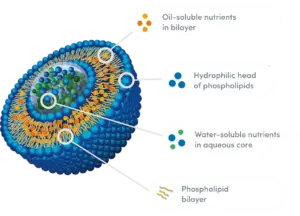
Figure: Liposome & Lipid Nanoparticle
Need for Liposomal Delivery
Many nutraceutical actives show low bioavailability due to poor solubility or rapid metabolism. Compounds such as curcumin, resveratrol, and fat-soluble vitamins are poorly absorbed in conventional formats. Liposomal co-formulation with amphipathic phospholipids increases dispersibility, improves membrane permeability, and enhances lymphatic uptake—bypassing first-pass metabolism.
Key Advantages
- Higher bioavailability via lymphatic transport
- Protection from gastric and enzymatic degradation
- Compatibility with both hydrophilic and lipophilic actives
Liposomal Formulation Techniques
Multiple preparation methods allow tuning of vesicle size, encapsulation efficiency, and scalability:
- Thin-Film Hydration: Produces multilamellar vesicles; further processed via sonication or extrusion to nano-sizes.
- High-Pressure Homogenization: Scalable method using high shear to form nano liposomes.
- Reverse-Phase Evaporation: Generates large unilamellar vesicles with high encapsulation efficiency.
- Microfluidic Mixing: Provides tight control over vesicle size and uniformity.
- Drying Methods: Spray- or freeze-drying create proliposomes that reconstitute in water.
Modern approaches focus on solvent reduction, stability enhancement, and scalable nano-liposomal production.
Phospholipids for Liposomes
Phospholipids, particularly PC, are the essential building blocks of liposomes. Their amphiphilic structure enables bilayer formation, payload encapsulation, membrane fusion, and efficient nutrient delivery.
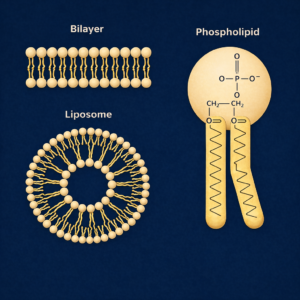
Core Functionalities
- Vesicle formation & structural stability
- Enhanced absorption through membrane interaction and lymphatic transport
- Protection of actives from acids, enzymes, and oxidation
- Controlled release and targeted delivery via customized lipid composition
- Biocompatibility & safety due to similarity to human cell membranes
- Compatibility with diverse actives including vitamins, botanicals, peptides, enzymes
- Customizability through modified fatty acid profiles, sterols, or surface functionalization
Choice of Phospholipids for Nutritional Liposomal Supplements
Phospholipid purity, composition, and source directly affect liposome stability, encapsulation efficiency, and performance.
- Sources:
- Soy: widely available, good hydration properties
- Sunflower: preferred for allergen-free or clean-label products
- Egg: high PC purity and strong vesicle forming capability
- PC concentration: Natural lecithin contains 20–25% PC; deoiled lecithin 30–40%; purified egg PC >50% improving nano-vesicle uniformity and entrapment efficiency.
- Physical form: Liquids for beverages; powders for capsules/sticks; purified PC for transparent nano-liposomal liquids.
- Fatty acid profile: Unsaturated PCs yield fluid bilayers suited for lipophilic actives; hydrogenated PCs improve oxidative and thermal stability.
- Compatibility: Hydrophilic actives (e.g., vitamin C) require hydrated bilayers; lipophilic actives (e.g., curcumin, CoQ10) benefit from more fluid membranes.
- Regulatory and market considerations: Sunflower PC for allergen-sensitive markets, egg PC for clinical nutrition, soy PC for cost-effective mass-market formulations.
Clinical and Experimental Evidence
Clinical evidence demonstrates the advantages of liposomal formulations in enhancing nutrient bioavailability. For instance, liposomal vitamin C powder showed approximately 30% higher plasma AUC compared to free vitamin C, sustaining elevated blood levels over an extended period. Similarly, liposomal iron supplements significantly improved iron absorption while reducing gastrointestinal side effects.
Meta-analyses consistently indicate that liposomal encapsulation can achieve multiple-fold increases in bioavailability compared to conventional formulations. These findings explain why modern supplement developers increasingly employ liposomes: a single liposomal dose can deliver more active compound into systemic circulation than an equivalent non-liposomal dose.
The following table provides a comprehensive summary of available clinical data on liposomal formulations and their efficacy.
| Active / Formulation | Mechanism / Role of Phospholipids | Outcome / Key Findings |
| Curcumin Phospholipid Complex | PC forms stable lipid bilayers, protecting curcumin from degradation & enhancing solubility | Up to 29x higher bioavailability; improved inflammatory markers[1] |
| Silybin Phospholipid Complex | Enhances intestinal permeability, reduces enzymatic breakdown, improves dispersion | 4-10x higher plasma silybin; better liver enzyme normalization[2] |
| Liposomal Glutathione | Protects from gastric/enzymatic degradation; facilitates cellular uptake | 30-40% higher blood glutathione; reduced oxidative stress[3] |
| Liposomal Vitamin C | Protects ascorbic acid from oxidation; prolongs plasma retention | Sustained plasma ascorbate; comparable to IV Vitamin C[4], [5] |
| Liposomal Iron | Minimizes mucosal irritation; enhances absorption | Higher ferritin & hemoglobin; fewer GI side effects[6] |
| Liposomal CoQ10 | Promotes solubility, lymphatic absorption, mitochondrial delivery | 2–3× higher plasma levels; improved mitochondrial function[7] |
| Vitamin D3 Liposomes | Enhances fat-soluble vitamin absorption via micelles & lymphatic transport | Higher, sustained plasma levels[8] |
Examples of Marketed Phospholipid Based Liposomal Supplements
| Brand | Region | Indication | Photo |
| LivOn Labs (Lypo-Spheric®) | USA / Global | Liposomal Vitamin C for immunity, antioxidant support, collagen synthesis | |
| Lipolife® | UK / Europe | Liposomal glutathione for detoxification, liver support, rapid absorption | |
| Doctor’s Formulas® | Greece / EU / Global | Liposomal curcumin complex for detoxification, oxidative stress protection | |
| Dr. Mercola® | USA / Global | Liposomal vitamin D3 for Immune support, bone & teeth health | |
| Quicksilver Scientific® | USA / Global | Liposomal methyl B Complex for energy metabolism, cognitive & nervous system function |
Representative Customers using VAV’s Phospholipids for Liposomal Supplements
| Region | Customer Description / Market Segment | Finished Dosage Forms Manufactured / Marketed |
| Europe | Nutraceutical CDMO, encapsulation specialist | Liquid liposomes, powdered liposomal granules, nano-emulsion drops |
| North America | Longevity & wellness supplement formulator | Liquid liposomal concentrates, oral sprays, gel sticks |
| South East Asia | Herbal & ayurvedic nutraceutical company | Capsule fill liposomal premixes, nano liposomal pastes |
| Middle East & Africa | Nutrition products CDMO | Fortification premixes, ready-to-drink liposomal solutions |
| Latin America | Cosmeceutical & biotech firm (CDMO) | Powdered nutricosmetic blends, oral gel sticks |
| Oceania | Nutrition & wellness products company | Liquid liposomal formulations, supplement drops |
Conclusion
Phospholipid-based liposomes deliver proven improvements in nutrient stability, bioavailability, and targeted delivery. High-purity phospholipids form robust nanovesicles that protect sensitive compounds and enhance absorption.
Scalable manufacturing methods now enable consistent, commercial-grade liposomal formulations. With strong clinical evidence and rising consumer demand for effective supplements, phospholipid-driven liposomal systems are rapidly becoming central to next-generation nutrition, cosmetics, and wellness products.
References
- Belcaro G, Cesarone MR, Dugall M, et al. Meriva curcumin phosphatidylcholine complex in osteoarthritis: efficacy and safety. Altern Med Rev. 2010;15(4):337–344.
- Semalty A, Semalty M, Rawat MSM, Franceschi F. Phytosome phospholipid polyphenol systems to enhance phytochemical bioavailability. Fitoterapia. 2010;81(5):306–314.
- Sinha R, Sinha I, Calcagnotto A, et al. Oral liposomal glutathione increases glutathione levels and immune markers. Eur J Clin Nutr. 2018;72(1):105–111.
- Davis JL, Paris HL, Beals JW, et al. Liposomal vitamin C: effects on bioavailability and protection against ischemia reperfusion injury. Nutr Metab Insights. 2016;9:25–30.
- Żmuda P, Khaidakov B, Krasowska M, et al. Bioavailability of powdered liposomal vitamin C: randomized cross-over study. Appl Sci. 2024;14(17):7718.
- Pisani A, Riccio E, Sabbatini M, et al. Oral liposomal iron vs. IV iron in CKD-related anemia: randomized trial. Nephrol Dial Transplant. 2015;30(4):645–652.
- López-Lluch G, Del Pozo-Cruz J, Sánchez-Cuesta A, et al. CoQ10 supplement bioavailability as influenced by carrier lipids. Nutrition. 2019;57:133–140.
- Dałek P, Drabik D, Wołczańska H, et al. Liposomal delivery systems for vitamin D₃: bioavailability by design. Nanomedicine. 2022;43:102552.